Order Automatica The 3x3 ritual grid
Nine cells, numbered attack order, cardinal adjacency, and tile effects that win fights before they start.
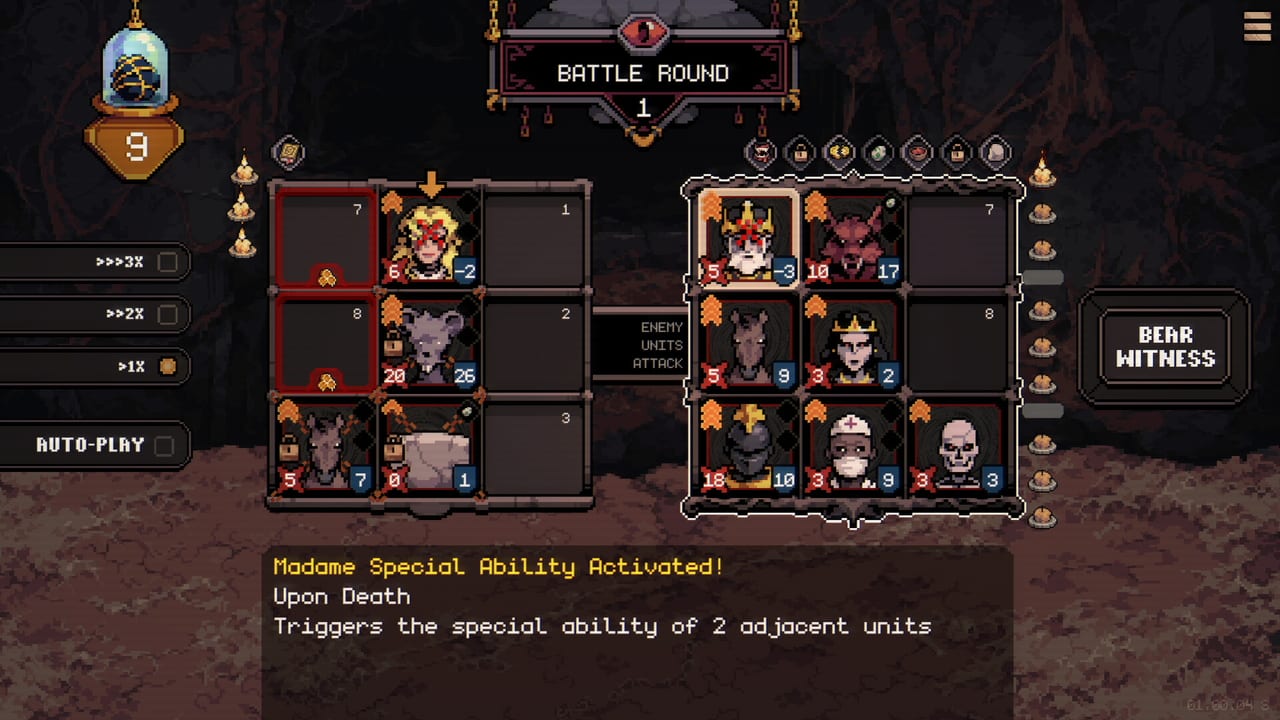
Every Order Automatica fight happens on two 3x3 boards facing each other. Your right-hand column is the front. Their left-hand column is their front. Cell numbers printed on empty tiles are not flavor; they are the turn order. If you remember one picture from this page, remember this player layout:
- Right column (closest to the enemy): 1 top, 2 middle, 3 bottom
- Middle column: 4 top, 5 center, 6 bottom
- Left column (backline): 7 top, 8 middle, 9 bottom
The enemy board mirrors that so their cell 1 is the portrait staring at your cell 1. When the tooltip says a unit attacks the occupant of the lowest numbered cell, it is hunting cell 1, then 2, then 3, and so on until it finds someone still alive.
Why front-line bodies exist
A 4-defense tank in cell 7 is a tank that never soaks the first hit. Put the wad of health in 1, 2, or 3. Put glass cannons and on-death engines behind them in 7-8-9 only after the front can survive the opening volley. Initiate enemies are polite about this. Penitent and Adept are not.
Column buffs care about the same geometry. An item that says “before battle, give +1 to all allies in this column” wants to sit in a column you actually filled. A lonely buffer in cell 7 with empty 8 and 9 is a wasted book. Stack the column first, then hang the item.
Adjacency is cardinal
When a tooltip says adjacent, it means up, down, left, right. Diagonals do not count. Madame’s Upon Death trigger (“triggers the special ability of 2 adjacent units”) is a placement puzzle, not a suggestion. Park her between two units whose abilities you actually want to fire, not in a corner where she only touches one friend.
Imp’s When Battle Begins (“deals 1 damage to all adjacent units”) is the opposite puzzle: it hits friends and foes if the text does not specify allies. Read the line twice. Some adjacent effects are team-wide, some are enemy-only, some are “units” with no filter. The Codex text is the law.
Hermit-style row summons want empty cells in that row. If you fill the entire row, the fish never appear. Leave gaps on purpose when your win condition is a corpse that populates tiles.
Cell 5 and “true cell” items
Several items and cell effects name a specific tile. Book of the True Cell, in demo footage, wanted the holder in cell 5 and then dealt damage to a random enemy as the round began. If you own an item that cites a number, that number is not a recommendation. Move the unit. The center tile also touches four cardinal neighbors, which is why Madame, Life Holder, and any adjacent-buff creature look better in 5 than in 1.
Cell effects are the other tile layer. Launch includes 18 of them: 9 positive, 9 negative. You buy them with the Cell Effect button during preparation. A positive example from early footage: before battle, the unit in this cell gains a chunk of defense, or immediately fires its special. A negative example: a cursed stone occupying a random empty cell so you cannot place anyone there. Positive effects should be claimed by the unit that scales off the trigger. Negative effects should be planned around, not ignored until End Preparation.
Hold slot versus grid slot
The Hold portrait to the left of your board is not cell 10. It does not attack. Some units, including the grey rat-style holder in demo builds, gain a random item when kept between battles. Use Hold for:
- Units whose out-of-combat trigger is better than their in-combat body
- A copy you plan to merge next shop
- An item sponge you are not ready to Distill
If you leave a tank in Hold, it will not soak cell 1. That sounds obvious until a Curse eats your front line and you wonder why the 20-defense rat never appeared.
Attack order as a weapon
Because low numbers strike first, you can snipe with a cell-1 assassin before the enemy tank in their cell 1 answers, or you can put a When Damaged scaler in cell 1 so it gets hit and grows before it swings. Flagellant-style units want to be punched. Summoners often want to die on their own terms, which may mean sitting in a higher number so they act after a Poison or a Distill kill during the shop.
Shop-phase deaths are persistent. If you equip Poison and kill your own Upon Death unit during preparation, the summons and buffs stay for the fight. That is not a bug. It is the point of shop, Distill, and merge.
A placement checklist before End Preparation
- Who eats the first attack? They belong in 1-2-3.
- Who needs neighbors? They belong in 5 or a filled plus-shape.
- Who needs empty tiles in their row or column? Leave those tiles empty.
- Who is holding a numbered-cell item? Move them to that number.
- Did a cell effect land on a tile you actually occupy?
- Is anyone important still sitting in Hold?
If you can answer those six questions without hovering, you are ready for Penitent. If you cannot, stay on this page and the Getting Started loop until the numbers feel like a keyboard. Then steal a finished shape from synergy builds and rank the portraits with the unit tier list.
Frequently Asked Questions
Quick answers for the current ritual.
What do the numbers on Order Automatica cells mean?
They are attack order. Lower numbers act first. On your board, the column closest to the enemy is 1, 2, and 3.
Does adjacent include diagonals?
No. Adjacent means the four cardinal directions only.
Why does my summoner do nothing?
Row and column summons need empty tiles. A full row cannot spawn fish, bones, or whatever the unit prints.
What is cell 5 for?
It is the center tile. Numbered items such as Book of the True Cell often require it, and it touches four neighbors for adjacency synergies.